Crypto Staking Rewards Explained – Start Earning Now

Crypto staking rewards let holders of certain cryptocurrencies earn passive income by locking their tokens to support blockchain operations. Unlike traditional savings accounts offering minimal interest, staking typically yields 3% to 15% annually. This guide covers the essentials: how staking works, popular cryptocurrencies, risks, tax implications for US investors, and practical steps to begin.
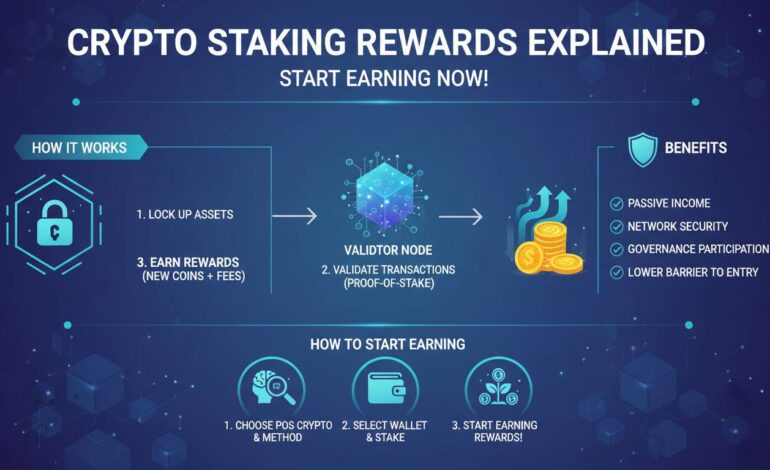
Crypto staking rewards are payments to participants who lock their cryptocurrency to support a proof-of-stake (PoS) blockchain network. Unlike Bitcoin’s energy-intensive proof-of-work system, PoS blockchains validate transactions through validators who stake their own tokens as collateral. These validators receive newly minted coins as rewards, which get distributed to everyone who has staked tokens.
The basic idea is straightforward: blockchains need participants to maintain operations. By locking up tokens, stakers show commitment to the network’s success and receive financial incentives in return. The rewards come from the blockchain’s token issuance schedule, making them a sustainable income source as long as the network operates.
Staking differs from traditional interest-bearing investments in a few ways. Yields are higher than conventional savings products. Rewards are paid in the blockchain’s native cryptocurrency, so holdings can compound as you reinvest earned tokens. Returns fluctuate based on network participation and token economics—they aren’t fixed like bank interest rates.
How Crypto Staking Works
PoS blockchains select validators to propose and confirm blocks based on how many tokens they’ve staked. More tokens staked means higher chances of being chosen to create the next block and earn rewards. This selection process keeps the network secure while operating efficiently.
To earn staking rewards, you need the native cryptocurrency of a PoS blockchain and a wallet that supports staking. Requirements vary—Ethereum requires 32 ETH minimum to run a full validator node, though staking pools let smaller investors participate. Cardano, Solana, and Polkadot have different minimums, making them accessible with varying capital levels.
Once staked, tokens remain locked for a specified period called the “unbonding period,” typically ranging from days to weeks depending on the blockchain. You can’t transfer or sell during this time without penalties. However, you continue earning rewards throughout the lockup, and those rewards usually get added to your staked balance for compound growth.
Several options exist for participating. Direct staking means running your own validator node—the highest rewards but requires technical expertise and substantial capital. Staking-as-a-service platforms handle the technical work while you earn a portion of rewards. Staking pools combine resources from multiple smaller investors to meet minimum requirements and share rewards proportionally.
Types of Crypto Staking Rewards
Understanding the types helps you choose a strategy matching your goals. The primary categories are protocol rewards from block creation, transaction fees paid by users, and inflation rewards from newly minted tokens distributed for network security.
Protocol rewards make up the bulk for most stakers. Each blockchain’s tokenomics determines these rates, with annual rates typically ranging from 3% to 15% depending on the blockchain and network conditions.
Liquid staking addresses a key drawback of traditional staking—inability to use staked assets for other purposes. With liquid staking, you receive a synthetic token representing your staked holdings, which can be used in decentralized finance applications while still earning rewards. This maximizes capital efficiency and has become popular among investors who want staking income while maintaining liquidity.
Lambda staking involves staking across multiple blockchain networks simultaneously. This diversifies reward streams and reduces exposure to any single network’s performance. However, it requires more complex setup and management, making it suitable for experienced investors comfortable monitoring multiple positions.
Popular Cryptocurrencies for Staking
Ethereum is the largest proof-of-stake blockchain by total value staked, with rewards varying from 3% to 8% annually depending on participation. After transitioning to PoS in September 2022, Ethereum became the default choice for many investors seeking staking rewards.
Cardano offers annual rewards typically between 4% and 6%. Its architecture lets holders delegate to stake pools without running their own nodes, making it accessible to anyone with any amount of ADA. The project’s emphasis on academic research and formal verification appeals to investors seeking a more conservative approach.
Solana has gained traction with annual rewards historically ranging from 6% to 12%. Its high throughput and low transaction costs make it popular for decentralized applications, creating strong demand for SOL staking. However, Solana has experienced several network outages, which can affect reward reliability.
Polygon, Polkadot, and Cosmos round out popular staking options, each offering different value propositions. These blockchains represent different approaches to interoperability and scalability. Research each project’s tokenomics, security track record, and development roadmap before committing funds.
Risks and Considerations
Staking offers attractive yields but carries real risks. Price volatility is the most significant—staked token values can swing dramatically based on market conditions. Even earning substantial rewards in percentage terms doesn’t matter if the underlying cryptocurrency drops significantly during your staking period.
Smart contract vulnerabilities matter too. While major PoS blockchains have undergone extensive security auditing, bugs or exploits in staking protocols can result in permanent loss of staked funds. The DeFi ecosystem has experienced numerous hacks where staked assets were compromised.
Liquidity risk affects anyone who needs capital quickly. Unbonding periods mean you can’t immediately withdraw staked tokens. Depending on the blockchain, this lockup can last from days to weeks—you can’t respond to adverse market developments or access funds during this time.
Slashing risk affects those running their own validator nodes. Validators who behave dishonestly or experience technical failures may have tokens destroyed as penalties. Most major staking platforms have robust infrastructure to avoid slashing, but this risk underscores the importance of using professional services if you lack technical expertise.
Tax Implications in the US
US investors face a complex tax landscape for staking rewards. The IRS treats cryptocurrency as property, meaning staking rewards are generally ordinary income at their fair market value when received. This applies whether you sell rewards immediately or hold them—receipt creates a taxable event.
The cost basis of staking rewards equals their fair market value on the day received. When you sell tokens later, you calculate capital gains or losses based on the difference between sale price and this cost basis. This creates a two-step tax process: rewards taxed as ordinary income when received, then any appreciation taxed as capital gains when sold.
Record-keeping is essential. Track the date, amount, and fair market value of all staking rewards received throughout the year. Many cryptocurrency tax software platforms support staking transactions, though verify your chosen platform captures this information properly.
Form 8949 and Schedule D matter for most participants who also have capital gains or losses. The IRS has increased scrutiny of cryptocurrency tax reporting in recent years, making accurate record-keeping and proper reporting more important. Consulting a tax professional specializing in cryptocurrency helps ensure compliance while identifying potential tax-saving strategies.
How to Start Staking
Starting requires several steps to approach this investment safely. First, acquire your target cryptocurrency through a reputable US-based exchange offering staking services—Coinbase, Kraken, and Binance.US all provide staking options for eligible customers, though availability varies by state.
After acquiring cryptocurrency, transfer it to a staking-compatible wallet or use your exchange’s staking service. For beginners, exchange-based staking offers the simplest path—the exchange handles technical aspects and automatically credits rewards. This sacrifices some potential returns but significantly reduces complexity.
For more advanced users, hardware wallets like Ledger or Trezor provide enhanced security for staked assets while supporting various staking platforms. These devices store private keys offline, protecting funds from online attacks. However, you interact with staking interfaces directly, requiring more technical knowledge and attention to security.
Regardless of approach, start with a small amount to understand the process before committing significant capital. Your first staking experience should focus on understanding mechanics rather than maximizing returns. As you gain confidence, expand across multiple cryptocurrencies and platforms.
Future of Crypto Staking Rewards
The staking landscape continues evolving as blockchain technology matures and institutional adoption grows. Major financial institutions have begun offering staking services to clients, bringing more legitimacy and capital to the ecosystem. This institutional participation has improved infrastructure and created more sophisticated products for retail investors.
Regulatory clarity will significantly influence staking’s future in the US. The SEC and CFTC continue developing cryptocurrency regulatory frameworks, with staking programs likely facing increased scrutiny. Clearer regulations could legitimate staking as mainstream, while excessive restrictions might limit options for US investors.
Technological advancement improves accessibility and efficiency. Layer 2 solutions and blockchain interoperability protocols make it easier to participate across multiple networks. Liquid staking derivatives and staking-as-a-service products are reducing barriers to entry.
The yield landscape will likely compress over time as more participants enter. Network reward structures decrease token issuance as adoption grows, naturally reducing staking yields. However, new blockchain launches and innovative tokenomics models will continue creating opportunities for early participants in promising projects.
Conclusion
Crypto staking rewards offer US investors a way to generate passive income from cryptocurrency holdings. By understanding mechanics, risks, and tax implications, you can make informed decisions about incorporating staking into your strategy. Yields exceed traditional savings products, though commensurate risks require careful management.
Starting with established cryptocurrencies like Ethereum or Cardano through reputable exchanges provides the safest entry point for most investors. As you gain experience, explore additional opportunities across different blockchains to diversify income streams and maximize returns. Prioritize security, maintain accurate tax records, and stay informed about regulatory developments affecting your activities.
The cryptocurrency market keeps maturing, and staking will likely play an increasingly important role in portfolio strategies. By educating yourself and approaching staking thoughtfully, you can position yourself to benefit from this evolving segment of the digital asset economy.
Frequently Asked Questions
What are crypto staking rewards?
Crypto staking rewards are earnings generated by holding cryptocurrency in a proof-of-stake blockchain network. Participants lock their tokens to support network operations like transaction validation, and in return, they receive newly minted tokens or transaction fees as rewards, typically paid annually ranging from 3% to 15%.
Is crypto staking safe?
Crypto staking carries risks including price volatility, smart contract vulnerabilities, and liquidity constraints during unbonding periods. However, using established blockchains and reputable platforms significantly reduces these risks. Never stake more than you can afford to lose, and consider using hardware wallets for enhanced security.
How do I start earning staking rewards?
To start, purchase cryptocurrency like Ethereum, Cardano, or Solana through a US-based exchange that offers staking. Transfer your tokens to a staking-compatible wallet or use the exchange’s staking service. Follow the platform’s instructions to delegate your tokens and begin earning rewards automatically.
Are crypto staking rewards taxable in the US?
Yes, the IRS treats crypto staking rewards as ordinary income at their fair market value when received. You must report these rewards on your tax return and pay income tax on them. When you eventually sell your tokens, any additional gains are subject to capital gains tax.
What is the difference between staking and yield farming?
Staking involves locking cryptocurrency to support a proof-of-stake blockchain and earning rewards for network participation. Yield farming involves moving assets between different decentralized finance protocols to maximize returns, typically carrying higher risk and complexity. Staking is generally considered more passive and less risky than yield farming.
Can I lose money from crypto staking?
Yes, you can lose money from crypto staking through token price declines that outweigh your earned rewards, smart contract failures, slashing penalties on validator nodes, or hacks on staking platforms. The primary risk is often the underlying cryptocurrency losing value during your staking period, which can result in net losses despite earning positive staking yields.